Meet Clockwise
AI agent Clockwise keeps an eye on timesheets and attendance, and lets you know if anything seems off. Stop fretting about late arrivals, missed shifts or curious absence patterns, and let Clockwise worry for you!
Watch this 4-minute video to learn more about Clockwise
See How Clockwise Works
Clockwise watches the clock for you, so that timesheets stay accurate and missed shifts or late entries are dealt with quickly.
All Clock Data Under One Roof
Clockwise gathers all time and attendance data, from every site and system, into one continuous feed that you can filter, sort or search.
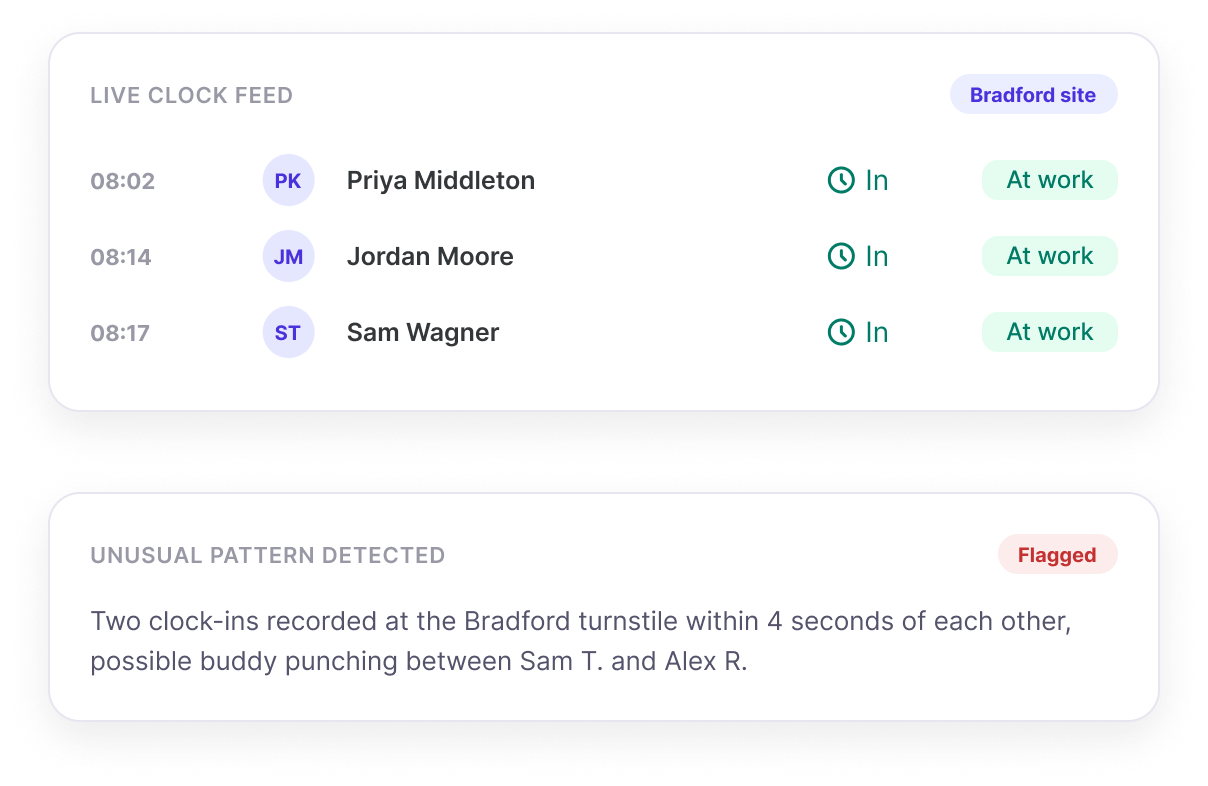
- Aggregate All Clock DataClockwise pulls together all entry and exit data from your different sites and sources, and presents them into one continuous, customisable feed.
- Spot Late TrendsClockwise looks for lateness trends to give you insights such as "Mary is late every Monday" or "your Bradford site has fifteen lateness events this week."
- Unusual Pattern DetectionClockwise looks for unusual trends, such as two people clocking in at exactly the same time as each other, to help you detect things like buddy punching or time theft.
Reduce Problem Absences and Lateness
Clockwise brings your attention to issues before they become problems, and even tells you what to expect based on historic data.
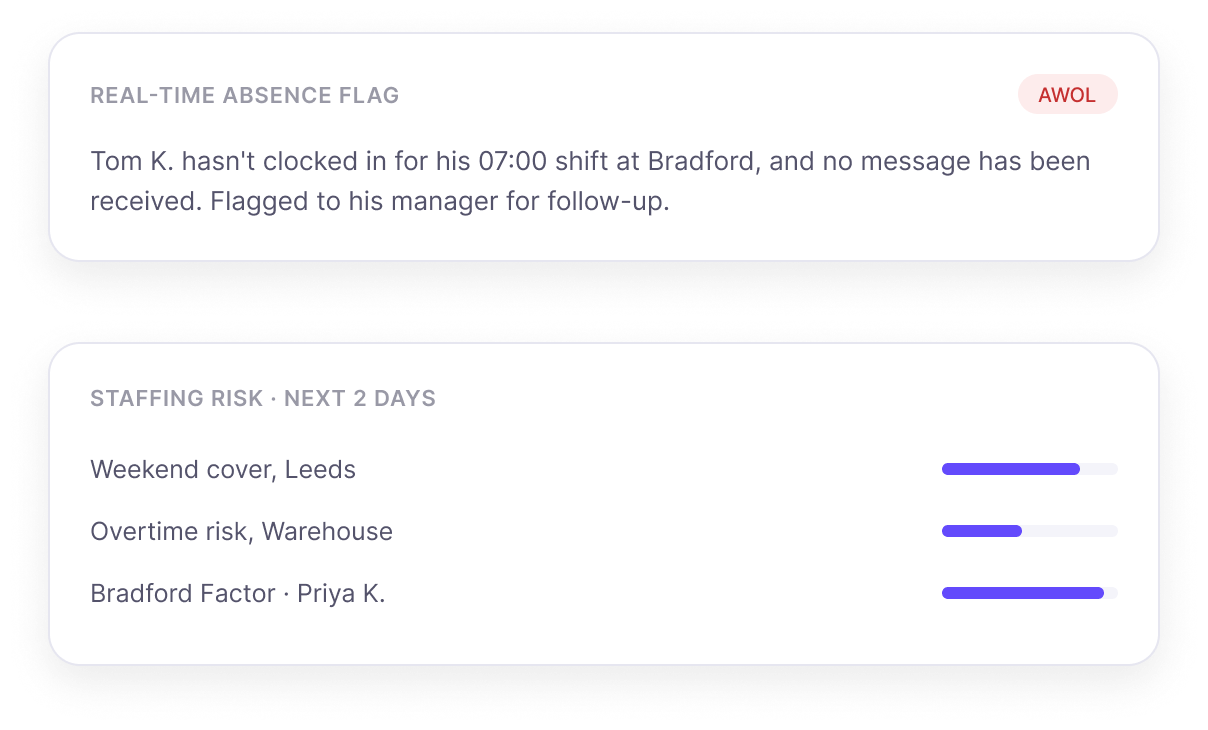
- Real-Time Absence FlagsClockwise can flag missed clock-ins to managers in real-time, helping them to investigate quickly and find cover fast in the event of an AWOL.
- Predictive AnalyticsClockwise can use current and historic attendance data to warn you of possible risks before they happen, such as staffing gaps that may occur in two days.
- Next Step RecommendationsClockwise can recommend next steps based on your company policies — such as suggesting an informal conversation when a certain Bradford Factor trigger is hit.
Understand Time and Attendance Data
Clockwise explains your time and attendance data in real, human terms, to help you find answers fast and report on the stats that matter.
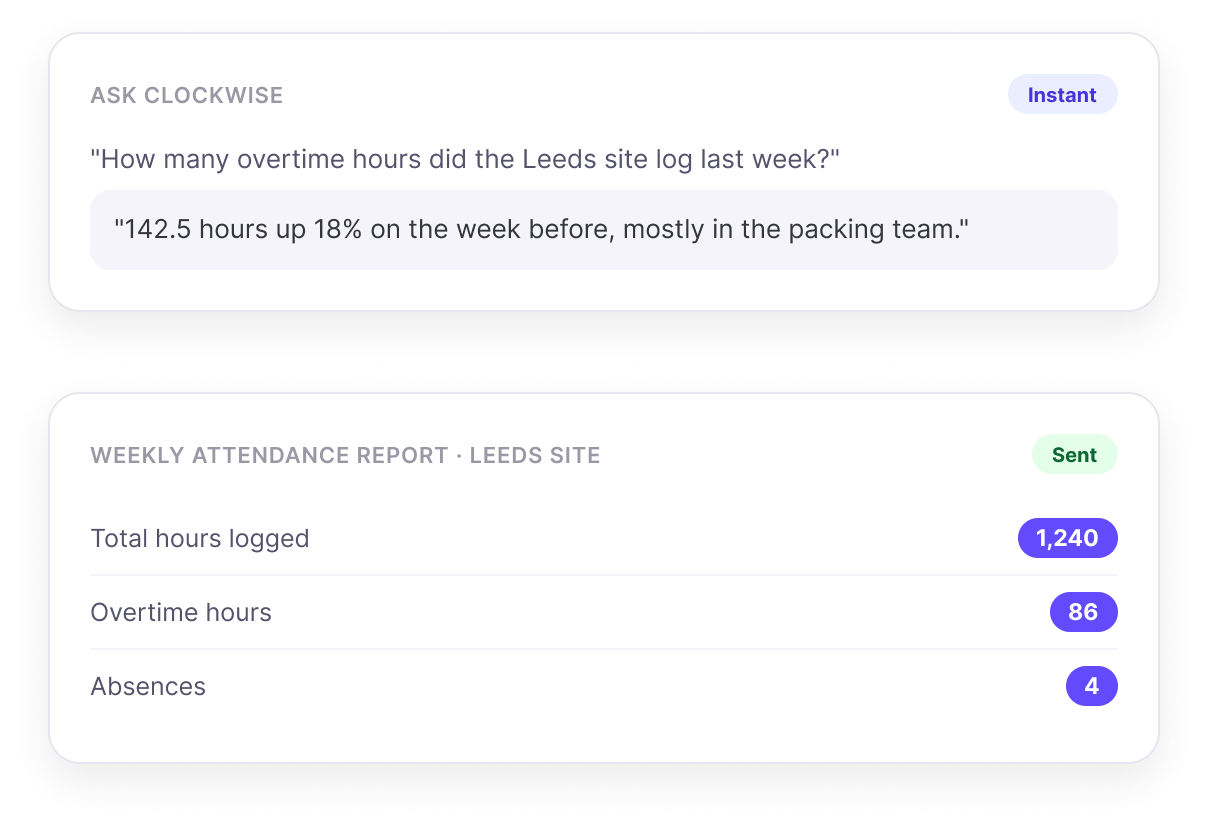
- Generate Regular ReportsClockwise can give you absence or attendance reports daily, weekly, or monthly, and filter them by site, by manager, by department or by team.
- Get Answers FastNo need to search through reams of data to find answers about hours, overtime, pay, shifts, or absences — just ask Clockwise, who will be happy to find the answer for you.
- Keep Sensitive Data SafeSense is ISO27001 certified, and all your HR data is stored in secure, UK-hosted data centres, compliant with GDPR. We never use your HR data to train any AI models.
Meet Clockwise in Person!
Share your contact details and one of our HR experts will be in touch to show you how you can stay ahead of time and attendance trends by adding Clockwise to your team of agents!
Common questions
Clockwise is an AI agent within Sense HR that monitors time and attendance data across all sites and clocking methods, and flags anomalies such as late arrivals, missed shifts, or unusual clocking patterns, so managers don't need to check timesheets manually.
Clockwise looks for patterns that fall outside what's normal for an employee, team or site, such as repeated lateness on a specific day, two people clocking in at exactly the same time as each other, or a sudden change in someone's usual attendance pattern. These are flagged for a manager to review, rather than acted on automatically.
No. Clockwise works alongside however staff already clock in, whether that's wall-mounted clocks, mobile app, or biometric devices, and pulls that data together into one continuous, searchable feed across every site.
Yes. Rather than searching through timesheets or attendance reports, managers can ask Clockwise a direct question, such as how much overtime a site worked last month, and get an answer without needing to run a report manually.
Yes. Clockwise can produce absence and attendance reports daily, weekly or monthly, filtered by site, manager, department or team, so managers can track patterns over time rather than reacting to individual incidents.
Clockwise looks for unusual patterns in clocking data, such as two employees clocking in at the exact same time from the same device, which can be an indicator of buddy punching, where one employee clocks in on behalf of another. These patterns are flagged for a manager to investigate, since Clockwise does not make disciplinary decisions itself.
Time and attendance fraud covers situations where recorded working hours don't reflect hours actually worked, such as buddy punching, clocking in early and leaving without clocking out, or repeatedly rounding hours in an employee's favour. It can be difficult to spot manually across a large or multi-site workforce, which is one reason employers use automated anomaly detection.
The Bradford Factor is a formula some UK employers use to measure the impact of employee absence, based on the number of separate absence episodes as well as total days lost, on the theory that frequent short absences disrupt a team more than one long absence. Clockwise can flag when an employee's absence pattern reaches a level that would normally trigger a conversation under a company's own policy.
Common approaches include cross-checking clock-in and clock-out data against submitted timesheets before payroll runs, flagging missing or unusual entries automatically, and giving managers real-time visibility of attendance issues rather than discovering them after payroll has already been processed.
Multi-site employers typically need a single, combined view of attendance data rather than checking each site's clocking system separately. Clockwise pulls attendance data from every site and clocking method into one feed, so patterns across the whole business, not just one location, become visible.
Sense is ISO 27001 certified, and all HR data, including attendance and clocking data used by Clockwise, is stored in secure, UK-hosted data centres compliant with GDPR. Customer HR data is never used to train any AI models.